
Russian Submarines Missions Are Risking International Data Cables

Frank Ocansey
Editor, PulseView
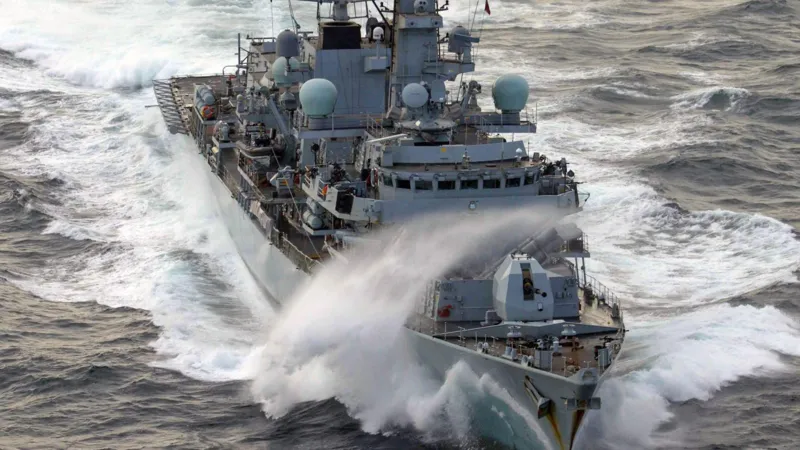
Russian Submarines: The UK Ministry of Defence has accused Russia of carrying out a covert submarine operation targeting critical undersea infrastructure in waters north of the United Kingdom, raising fresh concerns about the vulnerability of global communications and energy networks.
File photo of frigate HMS St Albans deployed to track the Russian submarine. Credit: BBC
Speaking at a Downing Street press briefing, John Healey revealed that three Russian submarines were detected operating near key undersea cables and pipelines in the North Atlantic. The vessels, he said, were part of what appeared to be a deliberate surveillance mission.
“We see you,” Healey warned, addressing Vladimir Putin directly. “We see your activity over our cables and our pipelines, and you should know that any attempt to damage them will not be tolerated and will have serious consequences.”
Russian Submarines: A covert mission exposed
According to UK defence officials, the operation involved an Akula-class attack submarine, believed to have acted as a diversion, while two highly secretive spy submarines linked to Russia’s deep-sea research unit conducted surveillance closer to sensitive infrastructure.
The UK responded by deploying a naval task group, including the frigate HMS St Albans, supported by aircraft and anti-submarine helicopters. Sonar buoys were dropped into the water to track the submarines’ movements, sending a clear signal that the operation had been detected.
Healey said the Russian vessels were closely monitored throughout. The attack submarine later withdrew, while the two specialist vessels remained in the area for a longer period.
Despite the activity, officials stressed there was no evidence of damage to UK infrastructure.
Russia denies allegations
The Russian Embassy in London rejected the claims, insisting Moscow poses no threat to British underwater infrastructure. Statements carried by Russian state media described the allegations as unfounded and accused the UK of escalating rhetoric.
However, Western defence analysts say such operations fall within a broader pattern of “hybrid warfare”—covert, deniable activities designed to probe vulnerabilities without triggering open conflict.
Why undersea cables matter
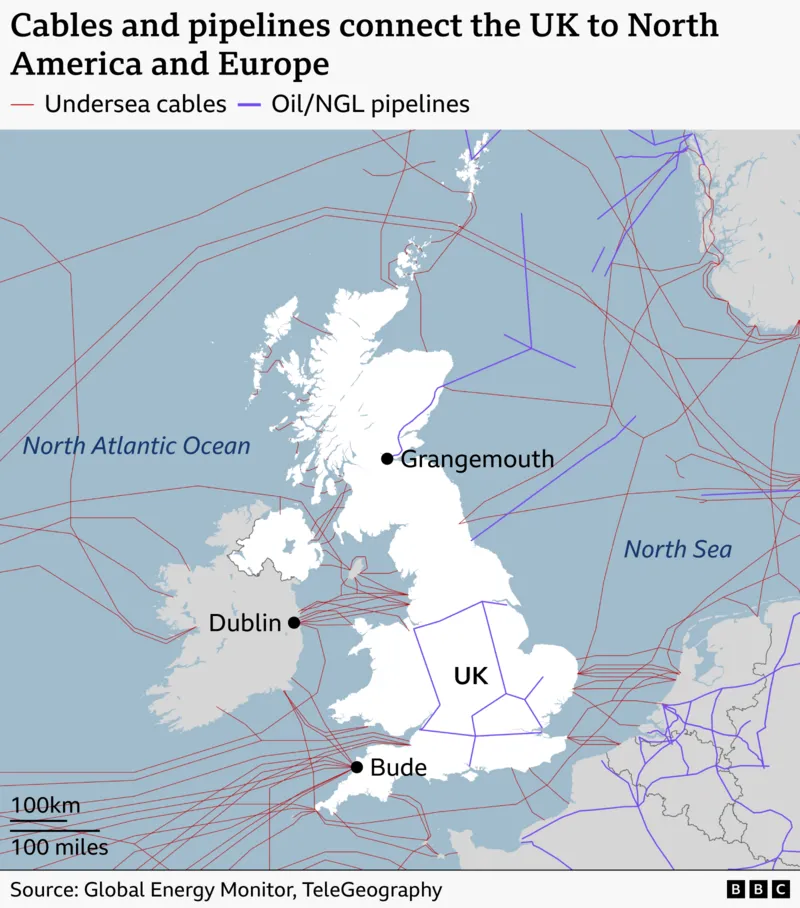
The stakes are high. The UK—and much of the world—relies heavily on a vast network of undersea cables and pipelines that carry both data and energy across continents.
More than 90% of the UK’s internet traffic travels through these fibre-optic cables, which stretch across the Atlantic and connect Europe to North America. At the same time, gas pipelines from countries such as Norway supply the majority of Britain’s imported energy.
This infrastructure is often located in remote or poorly monitored areas of the ocean, making it difficult to protect—and an attractive target in times of tension.
Security experts warn that any disruption could have far-reaching consequences, from internet outages and financial disruption to energy shortages.
The shadowy GUGI unit
At the centre of the concern is a little-known arm of the Russian military known as the Main Directorate for Deep Sea Research, commonly referred to as GUGI.
Unlike conventional naval units, GUGI specialises in deep-sea surveillance, reconnaissance, and sabotage. Its fleet includes advanced submarines and smaller, unmanned mini-submersibles capable of operating at extreme depths.
These mini-subs can be deployed discreetly from larger “mothership” vessels and are believed to have the capability to tamper with or even cut underwater cables. In some cases, analysts fear they could also intercept communications flowing through these networks.
Strategic signalling and global tensions
The UK government believes the operation may have been timed to exploit global distraction caused by conflicts elsewhere, particularly in the Middle East.
Keir Starmer said the UK would not “shy away from exposing destabilising activity,” linking the incident to broader concerns about Russian aggression.
Meanwhile, critics within the UK have questioned whether the country has sufficient naval capacity to respond to such threats. Some defence commentators argue that years of reduced maritime capability have left the Royal Navy stretched.
A wider pattern of “hybrid warfare”
This incident fits into a broader pattern identified by Western intelligence agencies, where Russia is accused of conducting covert operations below the threshold of war.
These actions can include cyberattacks, infrastructure surveillance, and interference in communications systems—all designed to test defences and gather intelligence without provoking a direct military response.
Experts say the ultimate concern is not what happens during peacetime, but what such reconnaissance enables in the event of a future conflict. Mapping cable routes and pipeline networks could give an adversary a significant advantage.
A fragile line beneath the sea
As geopolitical tensions continue to rise, the invisible infrastructure beneath the oceans is becoming an increasingly critical—and vulnerable—frontline.
While no damage has been reported in this case, the message from UK officials is clear: undersea cables and pipelines are now firmly in the spotlight of global security.
And as nations compete for strategic advantage, the quiet depths of the ocean may prove just as contested as the skies or the battlefield.
Source: BBC.com
Continue Reading

Ghana’s producer inflation edges up to 1.5% in March amid mixed sector performance
Producer inflation: Producer price inflation (PPI) in Ghana recorded a marginal increase in March 2026, rising to 1.5% from 1.4% in February, according to the latest data released by the Ghana Statistical Service (GSS). The slight 0.1 percentage point uptick reflects a modest increase in the cost of goods and services at the factory gate, […]
Frank Ocansey

Government announces reduction in fuel price as intervention takes effect April 16
Reduction in fuel price: The Government of Ghana has announced a reduction in the prices of petrol and diesel, set to take effect from April 16, 2026, as part of measures to cushion consumers against rising global fuel costs. Under the new directive, petrol will see a reduction of GH¢0.36 per litre, while diesel prices […]
Frank Ocansey

Gary Neville Urges Arsenal to Stay Calm Ahead of Title-Deciding Clash with Manchester City
Title-Deciding Clash: The Premier League title race has taken another dramatic turn, with Arsenal FC now under increasing pressure ahead of a crucial showdown against Manchester City. Former England defender Gary Neville has warned the Gunners that emotional control could be the key factor in determining the outcome of their season. With just a handful […]
 Junior Kojo