
Trump Announces 10% Tariffs on European Allies Over Greenland Pressure Campaign

Frank Ocansey
Editor, PulseView
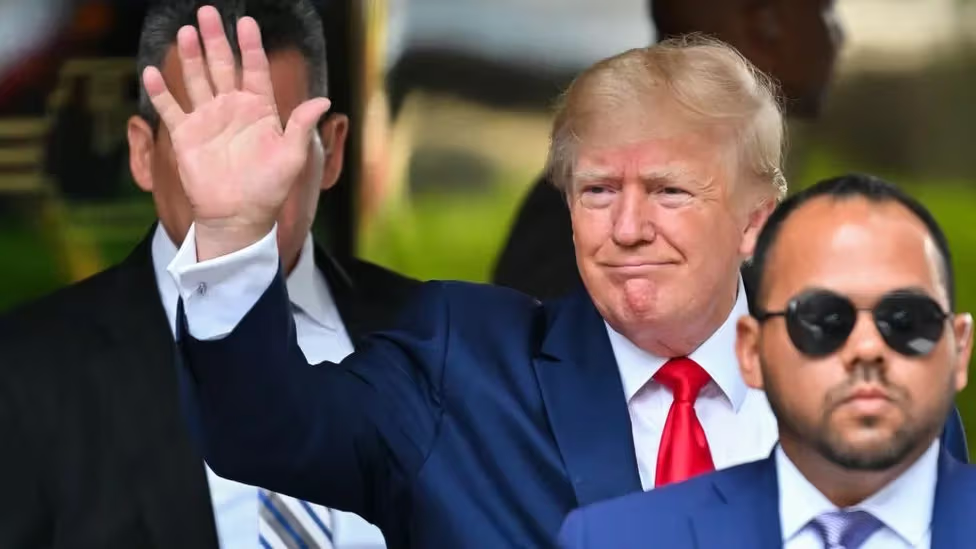
Trump Announces 10% Tariffs: U.S. President Donald Trump has announced a new round of tariffs targeting several European countries, intensifying pressure on Denmark over the potential sale of Greenland to the United States.
In a post on his social media platform Truth Social on Saturday, January 17, Trump revealed that the United States will impose a 10% tariff on imports from a group of European nations starting February 1. The affected countries include Denmark, Norway, Sweden, France, Germany, the United Kingdom, the Netherlands, and Finland all of which are longstanding NATO allies of the U.S.
According to Trump, the tariff rate could rise sharply if Denmark does not agree to negotiate a deal over Greenland.
“If Denmark does not make a deal to sell Greenland to the United States by June 1, the tariff will increase to 25%,” Trump wrote.
Trump Announces 10% Tariffs: Renewed Focus on Greenland
Trump’s interest in acquiring Greenland, a semi-autonomous Danish territory in the North Atlantic, dates back to his first presidential term. The mineral-rich, strategically located island has long been viewed by Trump as vital to U.S. national security, Arctic dominance, and economic interests.
Since returning to office nearly a year ago, Trump has renewed his fixation on Greenland, framing the acquisition as a geopolitical necessity amid growing competition in the Arctic from Russia and China.
European Response and Rising Tensions
Trump’s aggressive stance has already triggered diplomatic and military responses from Europe. In recent weeks, several European countries reportedly deployed troops to Greenland, signaling a show of solidarity with Denmark and underscoring concerns about regional security.
The move reflects growing unease among European governments over what they see as economic coercion tied to territorial demands.
Trump initially threatened trade penalties on Friday, before formally confirming the tariffs the following day.
Domestic Political Reaction
The announcement quickly drew criticism from U.S. lawmakers, including members of Trump’s own party.
Representative Don Bacon (R–Neb.) publicly condemned the strategy, describing it as “foolish” and warning that it risks damaging key alliances at a time of global instability.
Foreign policy analysts have also cautioned that targeting NATO allies with tariffs could undermine transatlantic cooperation, especially as the alliance faces ongoing security challenges in Eastern Europe and the Arctic region.
Economic Impact on Consumers
Once implemented, the tariffs will function as taxes on imported goods entering the United States from the affected countries. While the tariffs are levied on importers, companies often pass these additional costs on to consumers, potentially leading to higher prices on a wide range of products.
European exports to the U.S. include machinery, automobiles, pharmaceuticals, energy products, food items, and consumer goods, meaning the economic impact could be felt across multiple sectors.
Economists warn that escalating tariffs particularly a potential increase to 25% could disrupt supply chains, fuel inflation, and provoke retaliatory measures from Europe.
Legal Uncertainty Surrounding Tariffs
There is also growing legal uncertainty surrounding Trump’s authority to impose such tariffs unilaterally.
The U.S. Supreme Court is currently reviewing a case that will determine whether the president has broad constitutional authority to impose tariffs without congressional approval. The case stems from Trump’s controversial “Liberation Day” tariffs, announced in April of last year.
A ruling against expansive presidential tariff powers could significantly limit Trump’s ability to follow through on the proposed trade measures.
A High-Stakes Gamble
Trump’s decision marks a sharp escalation in his effort to leverage U.S. economic power to achieve foreign policy goals. While supporters argue the move demonstrates strong leadership and strategic bargaining, critics say it risks alienating allies, destabilizing markets, and weakening the global trade system.
With the February 1 implementation date approaching and the June 1 deadline looming, the coming months could prove pivotal for U.S.–Europe relations, global trade, and the future of Greenland’s geopolitical status.
Source: 3news.com
Also read: Trump’s $100bn Venezuela Oil Push Meets Industry Resistance
Continue Reading

Court of Appeal Restores GN Savings and Loans Licence in Major Victory for Defunct Financial Institution
Court of Appeal restores the licence of GN Savings and Loans after ruling that the revocation was unfair and unreasonable, ordering the receiver to hand over company assets and operations to shareholders. In a landmark ruling that could reshape Ghana’s financial sector clean-up debate, the Court of Appeal has unanimously overturned an earlier High Court […]
 Samuel Stefano

Global tensions rise as US weighs hypersonic missile deployment, Strait of Hormuz crisis deepens
Global tensions: A new report suggests the United States may deploy a hypersonic missile in the Middle East for the first time, signalling a potential escalation in efforts to pressure Iran into reaching a diplomatic agreement. The development comes as a key deadline passed for former US President Donald Trump to secure authorisation from Congress […]
Frank Ocansey
Civil society coalition petitions National Petroleum Authority to cut fuel supply to illegal mining operations
A coalition of civil society organisations has formally petitioned the National Petroleum Authority (NPA) to take urgent regulatory action to halt the flow of fuel to illegal mining operations, warning that continued access to diesel is sustaining widespread environmental destruction across Ghana. In a petition dated April 18, 2026, the Coalition Against Galamsey in Ghana […]
Frank Ocansey