UN Warns of Powerful El Niño That Could Trigger Extreme Weather, Food Crises and Record Global Temperatures
Frank Ocansey
Editor, PulseView
The United Nations has issued a stark warning that a new El Niño weather phenomenon could begin within weeks and potentially develop into one of the strongest events recorded in modern history. Scientists fear the combination of a powerful El Niño and ongoing human-induced climate change could reshape weather patterns across the globe, bringing devastating consequences for food production, water security, public health, and economic stability.
According to the World Meteorological Organization (WMO), the warming pattern developing in the Pacific Ocean is expected to intensify throughout 2026 and could become a rare “super El Niño” a phenomenon associated with some of the most severe weather disruptions ever recorded.
El Niño is a naturally occurring climate pattern that originates in the tropical Pacific Ocean.
Under normal conditions, strong trade winds push warm surface waters westward toward Asia and Australia, allowing cooler waters to rise near the western coast of South America.
However, during an El Niño event, these trade winds weaken or reverse direction. As a result, unusually warm ocean water spreads eastward across the Pacific Ocean, altering atmospheric circulation and influencing weather patterns worldwide.
Although it is a natural phenomenon, scientists say its impacts are becoming increasingly dangerous because it is now occurring on a planet already experiencing unprecedented warming due to greenhouse gas emissions.
Scientists Detect Strong Signs of a Developing Event
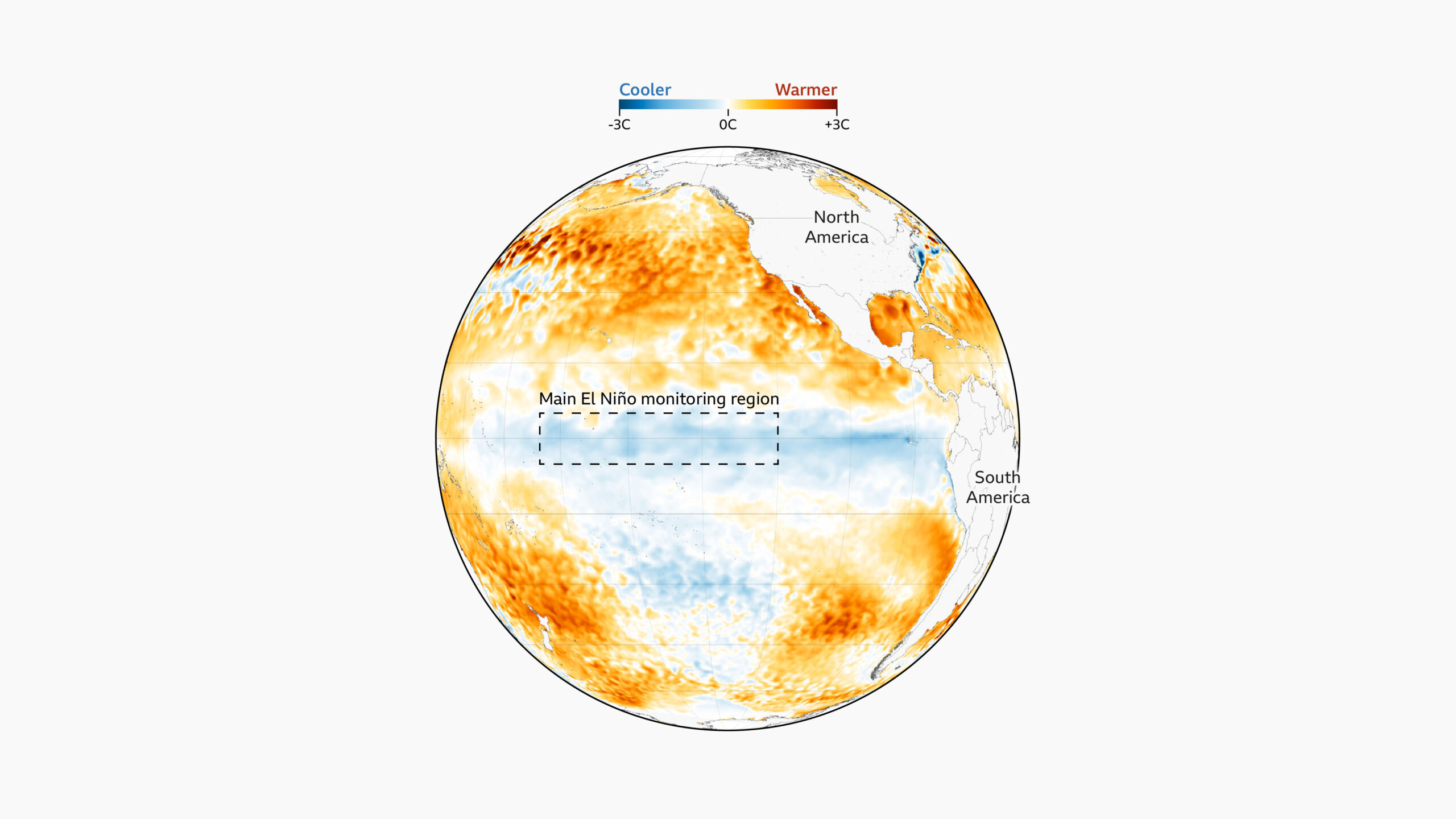
For months, climate scientists have been monitoring conditions in the central Pacific Ocean, particularly a region along the equator used as the primary indicator of El Niño development.
Recent satellite observations, ocean buoys, and underwater monitoring systems have revealed rapidly rising sea surface temperatures across the region. At the same time, exceptionally warm waters have been detected beneath the ocean surface, stretching hundreds of metres deep.
Scientists describe this hidden underwater heat as one of the strongest signals that a major event is approaching.
According to experts, some of these subsurface waters are currently more than 6°C above average, rivaling conditions observed during previous record-breaking episodes.
Professor Adam Scaife said researchers are increasingly confident that a significant event is on the horizon.
“We’re very confident that there’s a big event coming. It may even be a record event.”
Could This Become a “Super El Niño”?
Climate scientists classify El Nino strength according to how much sea surface temperatures rise above normal levels.
An El Niño is generally declared when ocean temperatures remain at least 0.5°C above average for several months.
It occurs when temperatures exceed 2°C above average.
Historical records show that only a handful of super El Nino events have occurred since 1950, including the powerful episodes of 1982–83 and 2015–16.
Current forecasting models suggest the upcoming event could reach between 1.8°C and 3.3°C above average, with many estimates centering around 2.7°C, placing it firmly within super El Niño territory.
If these projections are realised, the event could rival or even surpass some of the strongest event in recorded history.
Why the World Is Concerned
It affects weather systems worldwide by altering rainfall patterns, temperatures, storm activity, and ocean circulation.
The impacts vary across regions, but a strong El Niño has historically been linked to:
Severe Droughts
Countries in:
Australia
Indonesia
Papua New Guinea
India
Parts of South America
often experience significantly reduced rainfall during El Niño years.
These dry conditions can trigger:
Crop failures
Water shortages
Wildfires
Food insecurity
Flooding
Other regions may receive excessive rainfall.
Areas commonly affected include:
Southern United States
East Africa
Parts of East Asia
Heavy rainfall can increase the risk of:
Flash floods
Landslides
Infrastructure damage
Disease outbreaks
Weaker Monsoon Seasons
El Niño frequently weakens the Indian monsoon, which millions of people depend on for agriculture and water supplies. Reduced rainfall can have devastating consequences for food production and rural livelihoods.
Threats to Food Security
One of the greatest concerns associated with a strong El Niño is its potential impact on global food systems.
Past events have been linked to:
Reduced crop yields
Rising food prices
Supply chain disruptions
Increased hunger
Major agricultural commodities such as rice, wheat, maize, soybeans, and coffee can all be affected by droughts, floods, or extreme heat linked to El Niño conditions.
Developing countries are often the hardest hit because they have fewer resources to adapt to climate-related shocks.
The resulting shortages can contribute to inflation, economic instability, and humanitarian crises.
Economic Costs Could Be Enormous
The economic consequences of major El Niño events can be staggering.
Researchers estimate that previous strong El Niño episodes have caused hundreds of billions—and in some cases trillions—of dollars in global economic losses due to:
Agricultural damage
Energy disruptions
Infrastructure destruction
Health emergencies
Reduced productivity
Businesses and governments are therefore being urged to begin preparing now for potential disruptions.
El Niño Meets Climate Change
What makes this upcoming El Niño particularly concerning is that it is occurring against the backdrop of record global temperatures.
Scientists emphasize that El Niño itself does not cause long-term climate change. Instead, it temporarily boosts global temperatures by releasing additional heat from the Pacific Ocean into the atmosphere.
Climate change, on the other hand, is the long-term warming trend caused by human activities such as:
Burning fossil fuels
Deforestation
Industrial emissions
Historically, El Niño years tend to set new global temperature records.
Researchers estimate that a strong El Niño can increase average global temperatures by approximately 0.2°C.
Because the planet is already warmer than at any point in recorded human history, even a modest El Niño-related temperature boost could have profound consequences.
Could 2027 Become the Hottest Year Ever?
Several climate experts believe the next two years could see unprecedented heat records.
Climate scientist Zeke Hausfather said current evidence suggests that 2027 is now highly likely to become the warmest year ever recorded globally.
The concern is that the warming influence of El Niño will combine with already elevated greenhouse gas concentrations, pushing global temperatures to new extremes.
“El Niño conditions will pour fuel on the fire of a warming world. Impacts will hit even harder, travel even farther, and cross borders with devastating speed.”
The UN is urging countries to strengthen:
Early warning systems
Disaster preparedness plans
Agricultural resilience programmes
Water resource management
Climate adaptation strategies
before conditions worsen.
Looking Ahead
Although scientists cannot yet say with certainty how strong the event will become, there is growing consensus that the world should prepare for significant disruptions.
Whether the developing El Niño ultimately reaches record-breaking levels or not, experts warn that its effects will be amplified by ongoing climate change.
For governments, businesses, farmers, and communities worldwide, the coming months may prove critical in determining how effectively they can respond to what could become one of the most consequential climate events of the decade.
Data
Sea temperature maps
Data source: ERA5 C3S/ECMWF. Sea surface temperatures are compared with the 1991-2020 average.
El Niño temperature chart
Data source: Data source: Historical data from NOAA Relative Oceanic Niño Index, to March 2026. The Relative Oceanic Niño Index attempts to remove the influence of global warming to only show variations in the strength of El Niño and La Niña. Future projected range for November 2026 via Dr Zeke Hausfather. The forecast shows the estimated strength of El Niño based on six climate models from CanSIPS, NASA, NCAR and CFS. The range represents the middle 50% of model forecasts.
Data source: ERA5 C3S/ECMWF, NOAA Relative Oceanic Niño Index, data to March 2026. Pre-industrial average refers to the period 1850-1900. The regression trend line is indicative only.