
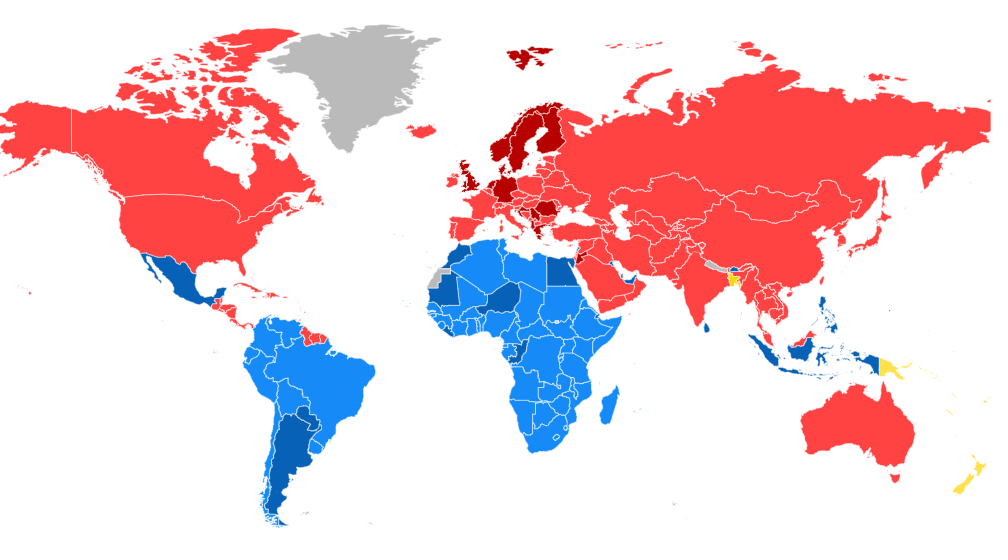
Fifa president Gianni Infantino: The map showing world’s division over Infantino

Frank Ocansey
Editor, PulseView
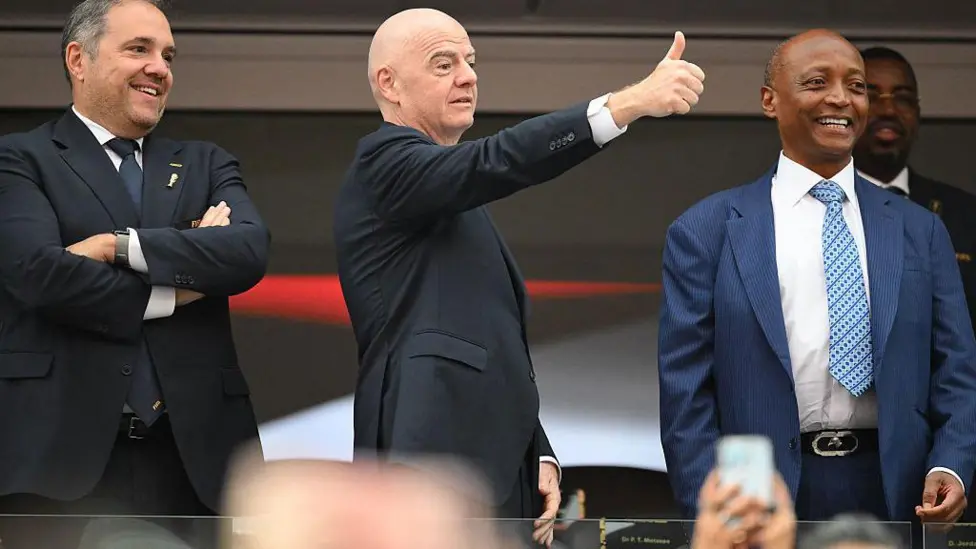
Fifa president Gianni Infantino’s position at the top of world football has changed dramatically in just a few weeks, with the once seemingly certain prospect of a fourth term now facing serious uncertainty.
As recently as mid-July, Infantino appeared almost certain to be re-elected as Fifa president in March 2027. Nearly all of Fifa’s 211 member associations had backed his candidacy, and there was no obvious challenger capable of mounting a serious campaign against him.
That situation has changed following the backlash over his now-abandoned proposal to create Fifa Forward Enterprise (FFE), a commercial subsidiary that would have allowed private investors to acquire minority stakes in Fifa’s major competitions and commercial operations.
The controversy has triggered an increasingly bitter dispute between Infantino and several of football’s major continental governing bodies.

A divided football world
BBC Sport’s assessment of the 210 Fifa members eligible to vote shows just how dramatically the situation has shifted.
At present, 73 associations are considered supportive of Infantino, 124 are opposed and 13 remain undecided. However, those figures are fluid and could change significantly before the election.
A candidate needs 106 votes to win a two-candidate Fifa presidential election.
The voting strength of the six confederations is:
- Uefa – 55 votes
- Caf – 54 votes
- AFC – 46 votes
- Concacaf – 35 votes
- Oceania – 11 votes
- Conmebol – 10 votes
This means that although Infantino currently faces substantial opposition, his position cannot be judged simply by counting the countries that have criticised him. The geographical distribution of those votes is equally important.
Europe leads the opposition
Europe has emerged as the strongest centre of resistance.
Several European associations, including England and Wales, have withdrawn letters of support previously submitted for Infantino’s re-election.
The opposition intensified when Uefa, Concacaf and the Asian Football Confederation (AFC) joined forces to accuse Fifa and Infantino of breaking their trust through what they described as deception.
Together, those three confederations represent 136 national associations, giving their opposition considerable potential weight.
However, the alliance is not completely united.
Some members have broken ranks. Bhutan, the Philippines and the United Arab Emirates have backed Infantino despite the AFC’s position.
In Concacaf, Mexico has openly supported Infantino, while the United States and Canada have supported the confederation’s statement without explicitly declaring that they want Infantino removed.
Africa could hold the key
One of Infantino’s most important sources of support remains Africa.
The Confederation of African Football (Caf), led by Patrice Motsepe, has not joined the criticism of Infantino. African football has received substantial investment through Fifa’s development programmes during Infantino’s decade in office.
That financial relationship could prove crucial.
Infantino may be able to use his support among African associations to compensate for some of the opposition emerging from Europe and Concacaf.
South America is another important source of support. Conmebol has also not criticised Infantino’s leadership over the FFE controversy.
The danger for Infantino, however, is that national associations do not necessarily have to follow the position of their continental confederation.
Asia could become the battleground
The AFC’s 46 votes could prove decisive.
While the continental body has joined Uefa and Concacaf in opposing Infantino, several Asian associations have already backed him.
That leaves a significant number of votes potentially available to either side.
Saudi Arabia is particularly important. The country has not yet publicly declared its position, while it is also preparing for football leadership elections of its own. The outcome could influence Saudi Arabia’s position and potentially affect other associations in the region.
If Infantino loses significant support in Asia, his chances of securing the 106 votes needed for re-election could deteriorate rapidly.
Could Victor Montagliani challenge Infantino?
Another major uncertainty is the identity of any challenger.
So far, no candidate has formally declared an intention to run against Infantino.
One name repeatedly mentioned is Victor Montagliani, president of Concacaf. His potential candidacy is significant because he could offer something European opposition alone may struggle to provide: a candidate capable of appealing beyond Europe.
There is a long-standing sensitivity within world football about the perception of European dominance. A challenger from Concacaf could therefore have a better chance of building a genuinely global coalition.
Another possibility would be an Asian candidate.
If AFC president Sheikh Salman decided to stand, for example, his candidacy could potentially attract Asian associations currently sympathetic to Infantino.
The identity of the challenger could therefore dramatically change the voting map.
What happens if Infantino refuses to resign?
Infantino has shown no indication that he intends to step down.
One possible route to removing him before the election would be an emergency meeting of the Fifa Council.
The council has 37 members. An emergency meeting can be triggered if 19 members request one, and it must then take place within two weeks.
However, securing those 19 votes is considered difficult because of the council’s geographical composition:
- Uefa – 9 members
- AFC – 7
- Caf – 6
- Concacaf – 5
- Conmebol – 5
- Oceania – 3
- Infantino and Fifa Secretary General Mattias Grafstrom
The numbers suggest that opposition would need to extend well beyond Europe and Concacaf to force a successful challenge through the council.
The presidential election could be the decisive battle
If Infantino remains in office, the most likely showdown will come at the Fifa Congress in March.
The deadline for potential candidates to declare their intention to stand is November.
For the opposition, the biggest challenge may not simply be removing Infantino but agreeing on one alternative candidate.
If Uefa, Concacaf and AFC support different candidates, they could split their votes and inadvertently allow Infantino to retain the presidency.
A single unity candidate would give the opposition a much clearer route to victory.
Why the situation remains unpredictable
The current voting map should not be regarded as a final prediction.
Some countries have openly declared their positions, others have privately communicated their views, while some positions have been inferred from statements made by their confederations.
More importantly, the political landscape is still changing.
Countries that currently support Infantino could change their position as the controversy develops. Others may remain loyal because of the financial benefits associated with Fifa’s development programmes.
The eventual challenger will also matter enormously.
A candidate from Europe could struggle to convince associations outside the continent that the campaign is about reform rather than European control of world football. A candidate from Africa, Asia or Concacaf could potentially build a broader coalition.
A presidency once considered secure is now under threat
The biggest change is therefore not that Infantino has definitely lost support, but that his re-election is no longer guaranteed.
Only weeks ago, he appeared to be heading towards another uncontested victory. Now, a significant bloc of football associations wants change, three major confederations have challenged his leadership, national associations are withdrawing their endorsements and potential challengers are being discussed.
Infantino still has powerful allies, particularly in Africa and South America, and he has demonstrated over the past decade that he is an effective political operator.
But the controversy surrounding Fifa Forward Enterprise has created something that previously appeared unlikely: a serious global challenge to his authority.
The crucial questions now are whether the opposition can maintain its unity, whether it can win over undecided associations and, most importantly, whether it can agree on a candidate capable of securing the 106 votes required to replace Infantino.
For now, the map of world football shows a governing body that is deeply divided and an election that has suddenly become genuinely competitive.
Fifa president Gianni Infantino
Source: BBC
Also Read: Gianni Infantino Calls Emergency FIFA Executive Meeting as Leadership Crisis Deepens
Continue Reading

Ozempic and Mounjaro Not Banned by WADA in 2027: But Athletes Face Warning
Athletes will remain permitted to use weight-loss drugs such as Ozempic and Mounjaro under World Anti-Doping Agency rules in 2027, but WADA is continuing to monitor the medications amid concerns about possible performance benefits, health risks and misuse in elite sport. The rapidly growing use of GLP-1 weight-loss medications has created a new challenge for […]
Frank Ocansey

Chelsea Spent £349m: So Why Are Two Right-Backs Playing in Midfield?
Chelsea spent £349 million during the summer transfer window and signed 10 first-team players, yet their 2-1 defeat by Arsenal ended with Reece James and Malo Gusto two players who began their careers as right-backs operating together in midfield. It was a striking image that raised a difficult question: have Chelsea rebuilt almost everywhere except […]
Frank Ocansey

How Harry Kane Scored 73 Goals by Dropping Deeper Than Ever for Bayern Munich
Harry Kane has just produced the most prolific season of his career, scoring 73 goals for club and country. What makes that achievement even more remarkable is that the Bayern Munich striker has been operating deeper than ever before sometimes appearing in midfield and even close to his own penalty area. Rather than reducing his […]
Frank Ocansey