
Hip Replacements: AI Designed Wonder Bone Could Revolutionise Hip Replacements and Fracture Treatment

Frank Ocansey
Editor, PulseView
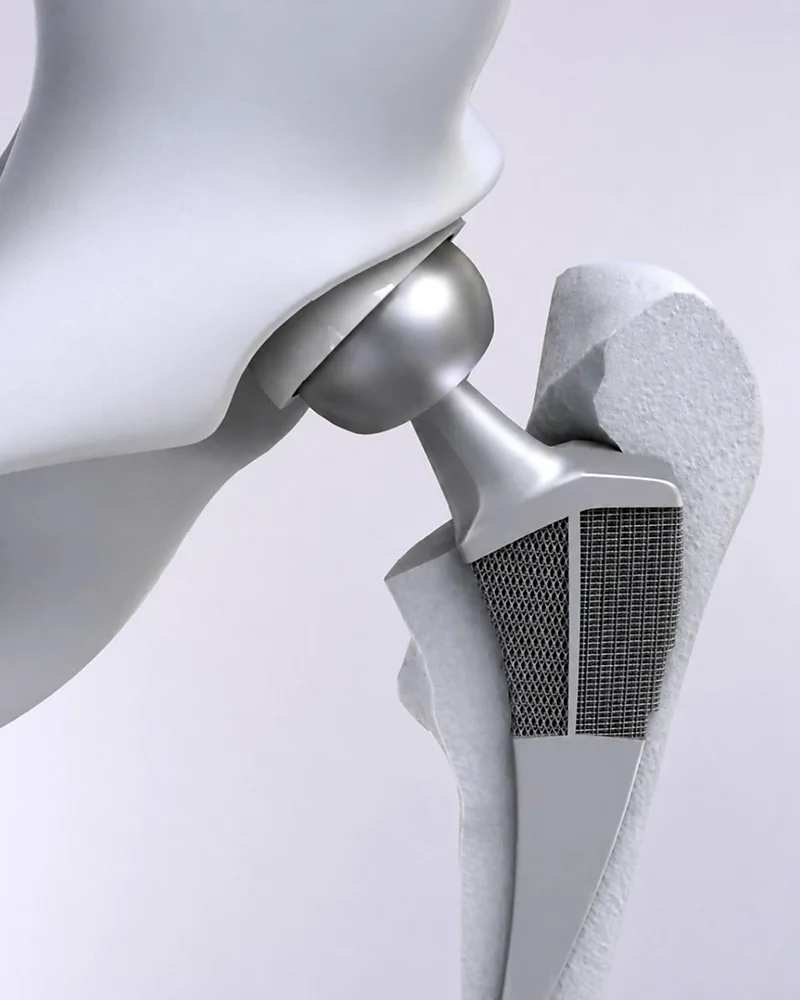
Hip Replacements: Scientists are developing futuristic bone-like materials powered by artificial intelligence that could dramatically improve hip replacements, speed up fracture healing, and transform the future of orthopaedic medicine.
Researchers say the breakthrough could lead to stronger, longer-lasting implants that behave more like real human bone solving one of the biggest challenges in modern orthopaedic surgery.
The cutting-edge research combines artificial intelligence, advanced materials science, robotics, and 3D printing to create so-called metamaterials specially engineered materials with unusual physical properties not commonly found in nature.
At the centre of the innovation is an extraordinary goal: designing a material that becomes thicker when stretched while remaining stiff enough to support the human body something scientists once considered nearly impossible.
Why Scientists Are Reinventing Artificial Bones
Hip replacements remain one of the most common surgical procedures worldwide.
However, traditional implants face a major problem: the human body places enormous pressure on them every day. Researchers estimate that people with artificial hips take nearly two million steps annually, placing continuous stress on the implant.
Over time, this wear and tear weakens implants, often forcing patients to undergo painful and expensive revision surgeries after 10 to 15 years.
Professor Amir Zadpoor and his research team at Leiden University Medical Center wanted to solve this issue by creating a material that behaves more like natural bone.
Their idea was to build a special structure around hip implants that could cushion pressure while maintaining a strong connection between the implant and the bone itself.
According to Amir Zadpoor, the ideal material needed two almost contradictory properties:
- It had to become thicker when stretched
- It also had to remain extremely stiff and durable
That combination proved incredibly difficult to achieve using conventional materials science.

The Strange Science Behind “Auxetic” Materials
Most materials become thinner when stretched.
For example, when you pull both ends of an elastic band, it narrows in the middle.
But auxetic materials behave differently. Instead of thinning, they become thicker when stretched.
These unusual materials are already used in products like:
- Crash helmets
- Protective padding
- Knee guards
However, most auxetic materials are soft and flexible unsuitable for supporting heavy loads inside the human body.
Researchers therefore faced what Amir Zadpoor described as the “holy grail” challenge: finding an auxetic material that was also stiff and strong enough for bone implants.
Artificial Intelligence Solves the Impossible
To overcome the challenge, scientists turned to artificial intelligence.
Using machine learning systems trained to predict how different materials would behave, researchers entered the exact properties they wanted into the AI model.
The system then generated entirely new microscopic structures for materials capable of achieving those properties.
The result was the creation of “metamaterials” engineered materials whose unusual behaviour comes from their internal structure rather than their chemical composition.
These AI-generated designs could potentially:
- Absorb stress more effectively
- Fit more naturally into the body
- Reduce implant loosening
- Improve long-term durability
- Mimic the behaviour of real human bone
Researchers say this would have been almost impossible to discover using traditional engineering methods alone because of the enormous number of structural combinations involved.
“With machine learning, you can make the process orders of magnitude faster,” Zadpoor explained.

AI Could Help Broken Bones Heal Better
The technology is not limited to hip replacements.
Another research team at TU Delft and ETH Zurich is using AI to develop softer, bone-like implants that could improve fracture healing.
Current fracture treatments often rely on:
- Steel plates
- Titanium rods
- Screws and pins
While effective, these materials are significantly stiffer than human bone.
Because they absorb most external pressure themselves, the surrounding bone sometimes weakens instead of healing properly a phenomenon known as stress shielding.
Researchers believe softer, porous implants that more closely resemble natural bone tissue could solve this problem.
Mimicking the Hidden Structure Inside Human Bones
Inside long bones such as the femur is a lightweight, honeycomb-like structure called trabecular bone.
This porous internal network provides:
- Strength
- Shock absorption
- Flexibility
- Reduced weight
Scientists wanted to replicate this structure using AI-designed metamaterials.
Using machine learning, researchers developed a new class of metamaterials called “spinodoids,” which closely mimic the irregular lattice structure found in real bone.
The AI system was trained to reproduce properties such as:
- Bone stiffness
- Curvature
- Porosity
- Structural strength
- Force distribution
According to researchers, this level of precision could eventually allow implants to integrate more naturally into the body and encourage living tissue to grow around them.
3D Printing and Personalised Implants
One of the most exciting aspects of the research is the possibility of creating fully personalised implants.
Scientists say future AI systems may be capable of designing implants tailored specifically to a patient’s anatomy.
These implants could be:
- 3D printed
- Adjusted to individual bone shapes
- Designed for different stress levels in various body regions
- Modified to encourage tissue growth in targeted areas
This personalised approach could significantly improve implant lifespan and reduce complications after surgery.

Implants That Expand Inside the Body
Researchers are also exploring “deployable implants” compact implants inserted through small openings that later expand once inside the body.
Using AI-designed metamaterials, scientists have already created structures capable of expanding in multiple directions simultaneously and even changing shape in response to electrical currents.
Experts believe this could dramatically reduce the need for invasive surgery in the future.
The Future of AI in Medicine
The breakthrough highlights the rapidly growing role of artificial intelligence in healthcare and biomedical engineering.
AI is increasingly being used to:
- Design new medicines
- Predict diseases
- Assist surgeries
- Develop personalised treatments
- Engineer advanced medical materials
Researchers say AI’s ability to process millions of design possibilities in seconds makes it particularly valuable in materials science, where discovering new structures using conventional methods can take years.
While many of these bone-like materials are still undergoing testing, scientists believe they could eventually transform orthopaedic medicine and significantly improve quality of life for millions of patients worldwide.
Source: BBC
Also read: AI-Powered Plant Health Scanner Wins Prestigious Award at Chelsea Flower Show
Continue Reading

How to Get Rid of Brain Fog: 9 Simple Ways to Improve Focus and Mental Clarity
Brain fog can make it difficult to concentrate, remember simple things or think clearly. While it is not a medical condition on its own, it can leave you feeling mentally slow and overwhelmed. The good news is that small changes to your daily routine may help improve focus, reduce mental overload and support better brain […]
Frank Ocansey

What Screen Time Really Does to Children’s Brains: What the Science Says
Screen Time: Parents are repeatedly warned that smartphones, tablets, gaming and social media could damage children’s brains. But despite growing concern about screen use, researchers remain divided over how harmful it really is — and whether the amount of screen time matters as much as what children are actually doing online. Screen time has become […]
Frank Ocansey

Box Breathing for Stress: How the 4-4-4-4 Technique Helps Calm Your Nervous System
Box breathing has become one of the most popular breathing techniques for managing stress, anxiety and moments of intense pressure. Used by athletes, military personnel and people struggling with sleeplessness, the method is remarkably simple: breathe in, hold, breathe out and hold again for equal amounts of time. But what actually happens inside the body […]
Frank Ocansey