
President Mahama outlines economic recovery amid new global risks

Frank Ocansey
Editor, PulseView
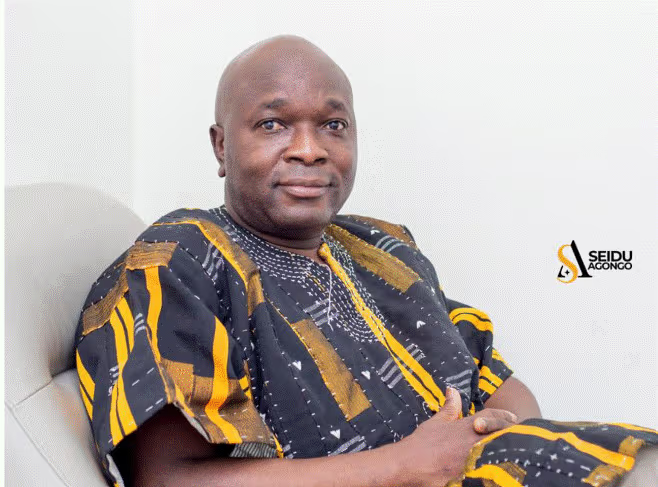
President Mahama says Ghana’s economy is stabilising, but cocoa price collapse and Middle East war pose fresh threats.
President John Dramani Mahama last Friday delivered a calm yet confidence-boosting assessment of Ghana’s economic direction in the second State of the Nation Address of his second term.
After years marked by high inflation, a weakening cedi, debt restructuring and subdued business activity, the President painted a picture of cautious recovery. His remarks echoed what many households and firms say they are beginning to feel — easing pressure on the cost of living and greater predictability in the broader economy.
Key macroeconomic indicators are stabilising. Inflation, which peaked at 54% in 2022, moderated to about 23% in 2024 and reportedly fell further to 3.3% in February 2026. For ordinary Ghanaians, these figures are not just statistics; they are reflected in slower increases in food prices, transport fares and utility bills.
For businesses, a relatively steadier cedi and improved supply conditions have reduced the uncertainty that once made planning nearly impossible.

From hardship to cautious optimism
The President’s address underscored improvements in macroeconomic management, fiscal discipline and revenue mobilisation. While acknowledging that challenges remain, the tone was one of forward momentum rather than crisis containment.
Market traders, manufacturers and salaried workers alike are beginning to see modest relief. However, the recovery remains fragile.
Cocoa price crash
Just as stability appeared to be taking root, external shocks emerged.
The first major setback is the dramatic collapse in global cocoa prices. After soaring to nearly $10,000 per tonne in 2024, cocoa prices have fallen sharply to around $3,026 per tonne as of March 4, 2026.
The slump forced Ghana to reduce its producer price by 28.6% to GH¢41,392 per tonne for the 2025/26 season. With global prices reportedly down nearly 70% from their late-2024 peak, export revenues have narrowed significantly, placing pressure on both government finances and farmer incomes.
Neighbouring Ivory Coast has also cut its farm gate price, highlighting how the downturn is affecting the entire West African cocoa belt.
Middle East war and oil risks
A second and potentially more volatile threat stems from escalating tensions in the Middle East, particularly involving Israel, the United States and Iran. The renewed geopolitical strain has injected uncertainty into global commodity markets.
For Ghana — a small, open economy dependent on imported fuel and external capital flows — the risk is significant. Analysts warn that prolonged instability could push crude oil prices above $100 per barrel.
If that happens, the likely consequences include:
- Higher fuel pump prices
- Rising transport fares
- Increased production costs for businesses
- Renewed upward pressure on inflation
- Potential currency volatility
Global crises also tend to dampen investor sentiment, which could complicate Ghana’s re-entry into international capital markets following debt restructuring.
Ghana’s resilience and policy response
Despite these challenges, Ghana enters this uncertain period with some advantages. The country has navigated multiple economic shocks over the decades — from commodity price swings to financial sector reforms and the COVID-19 pandemic.
President Mahama’s prior leadership experience is also relevant. During his earlier tenure (2013–2017), Ghana faced significant capital flight, exchange rate depreciation and a severe energy crisis. Through reforms and investments, the power supply situation improved, leaving excess installed capacity that continues to benefit the country today.
The current administration has introduced stricter fiscal measures, revenue mobilisation efforts and the establishment of a Gold Board to strengthen buffers. However, sustaining these gains will require continued discipline.
Accelerating domestic food production, strengthening small and medium-sized enterprises and reducing reliance on imports are likely to be central pillars of resilience.
The role of citizens and businesses
Economic recovery is not driven by policy alone.
Households may need to prioritise financial planning, cut unnecessary spending and explore diversified income streams. Businesses must remain disciplined, anticipate cost pressures and adopt innovative strategies to stay competitive.
This moment also presents opportunity. Investment in digital tools, renewable energy solutions and efficient logistics systems can enhance resilience in uncertain times.
Above all, national unity and collective steadiness will be critical. Ghana has weathered severe storms before — including the COVID-19 pandemic and a complex debt restructuring process.
The recovery highlighted in the State of the Nation Address is real, but it must be protected. With careful policy management and shared responsibility, Ghana can sustain its progress even as the global environment grows more turbulent.
Source: 3news.com
Also read: Cocoa Price Cut Sparks Debate: Ghana Slashes Producer Price to GH¢2,587
Continue Reading

Court of Appeal Restores GN Savings and Loans Licence in Major Victory for Defunct Financial Institution
Court of Appeal restores the licence of GN Savings and Loans after ruling that the revocation was unfair and unreasonable, ordering the receiver to hand over company assets and operations to shareholders. In a landmark ruling that could reshape Ghana’s financial sector clean-up debate, the Court of Appeal has unanimously overturned an earlier High Court […]
 Samuel Stefano

Women vs men empathy: Are Women Naturally More Empathetic Than Men? Scientists Say the Truth Is More Complex.
Women vs men empathy: For generations, society has promoted the idea that women are naturally more emotional, nurturing, and empathetic than men. From childhood toys and parenting styles to workplace expectations and leadership stereotypes, empathy has long been treated as a “feminine trait,” while assertiveness, dominance, and emotional restraint are often associated with masculinity. But […]
Samuel Stefano

Surrogacy in Ghana: Recognised by Law, Yet Still Shrouded in Uncertainty
Surrogacy is no longer a distant or unfamiliar concept in Ghana. It is steadily becoming part of the country’s evolving reproductive and family landscape. Today, more couples facing infertility are turning to assisted reproductive technologies. More fertility clinics are facilitating such arrangements. More legal practitioners are being engaged to structure agreements and navigate the emerging […]
Frank Ocansey