
University Project in Damongo: Ghana and China Sign US$30 Million Grant Agreement

Frank Ocansey
Editor, PulseView

University Project in Damongo: Ghana and the People’s Republic of China have signed a US$30 million grant agreement to support the construction of a new university in Damongo, marking another major milestone in the long-standing diplomatic and development cooperation between the two countries.
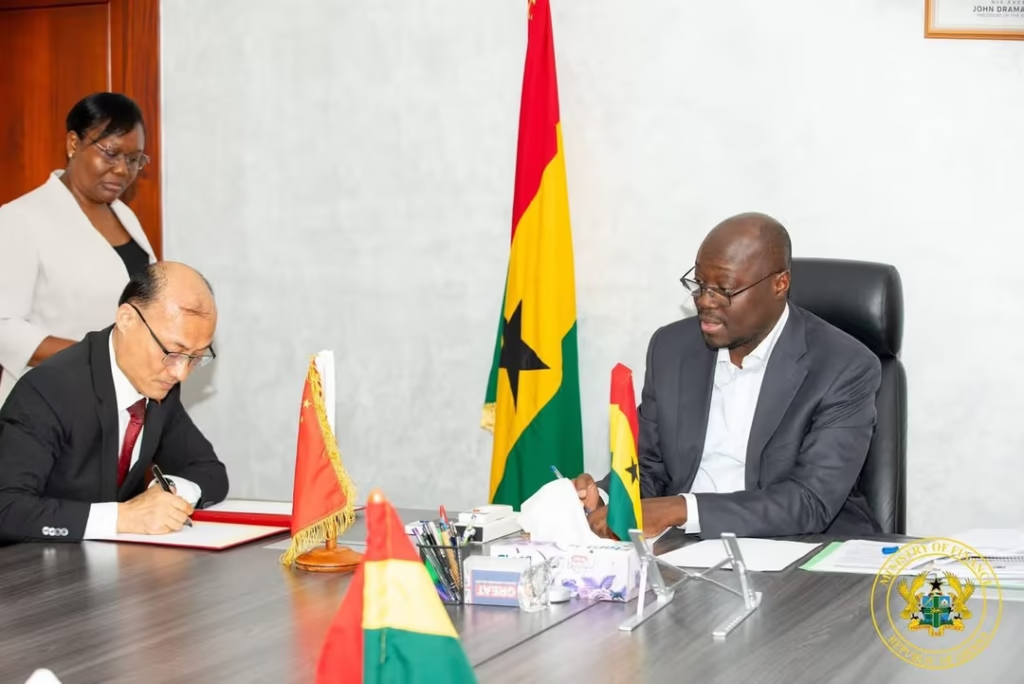
The agreement was signed during a high-level meeting between Ghana’s Minister for Finance, Dr Cassiel Ato Forson, and the outgoing Chinese Ambassador to Ghana, H.E. Tong Defa, underscoring China’s continued commitment to supporting Ghana’s education and infrastructure development agenda.
Strengthening Ghana–China Development Cooperation
Speaking at the signing ceremony, Dr Cassiel Ato Forson expressed deep appreciation to Ambassador Tong on behalf of President John Dramani Mahama and the people of Ghana, acknowledging the H.E. Tong Defa role in strengthening bilateral relations between the two nations.
According Dr Cassiel Ato Forson, although Ambassador Tong’s tenure in Ghana was relatively brief, it was highly impactful, culminating in the successful conclusion of two major grant agreements.
These include funding support for a multipurpose market in Aflao and the US$30 million grant for the construction of the Damongo university, both of which are expected to contribute significantly to local economic development and human capital formation.
“Your tenure, though short, has been very productive and impactful. It coincided with the successful conclusion of two important grant agreements that will leave a lasting legacy for Ghana,” Dr Forson said.
University Project to Boost Education in Northern Ghana
The construction of the university in Damongo is expected to expand access to tertiary education, particularly for students in the Savannah Region and northern Ghana. Education sector analysts say the project could help address long-standing regional disparities in access to higher education and skills development.
Once completed, the institution is anticipated to:
- Improve enrolment in tertiary education in northern Ghana
- Support local economic activity through job creation
- Serve as a hub for research, innovation, and community development
- Reduce the cost and burden of long-distance travel for students seeking higher education
The project also aligns with Ghana’s broader national development objectives of strengthening human capital and promoting inclusive growth across all regions.
China’s Growing Contribution to Ghana’s Economy
Dr Cassiel Ato Forson highlighted the broader role of Chinese investment and development support in Ghana’s economy, describing China as one of Ghana’s most reliable and long-standing development partners.
He reaffirmed Ghana’s appreciation for the historic relationship between the two countries, noting that diplomatic ties date back to the era of President Kwame Nkrumah and Chairman Mao Zedong.
“Ghana deeply values its relationship with China, which has spanned decades and continues to deliver tangible benefits in infrastructure, trade, education, and economic development,” the Minister stated.
Over the years, Chinese support has contributed to major projects in roads, energy, healthcare, education, and industrial infrastructure, reinforcing Ghana’s development trajectory.
Call to Reduce Exchange Losses in Bilateral Trade
Beyond development cooperation, Dr Cassiel Ato Forson used the occasion to raise concerns about exchange losses associated with bilateral trade, particularly Ghana’s reliance on third-party currencies such as the US dollar when trading directly with China.
He emphasized that such arrangements often lead to inefficiencies and unnecessary foreign exchange exposure for both countries.
As part of efforts to deepen economic cooperation, the Finance Minister indicated Ghana’s interest in exploring direct trade settlements in the Ghanaian cedi and the Chinese renminbi (RMB).
“When trade is conducted directly between Ghana and China, reliance on third-party currencies becomes inefficient. There is a strong case for exploring settlements in our local currencies to reduce exchange losses,” Dr Cassiel Ato Forson explained.
Engagement with the Bank of Ghana
Dr Cassiel Ato Forson assured Ambassador Tong that discussions on local currency trade settlement would be pursued at the policy level, including formal engagement with the Bank of Ghana (BoG) and other relevant stakeholders.
Such a move, analysts note, could help:
- Reduce pressure on Ghana’s foreign exchange reserves
- Lower transaction costs for businesses
- Improve trade efficiency between Ghana and China
- Strengthen macroeconomic stability
Local currency trade settlement has become an increasingly popular option globally, especially among emerging economies seeking to reduce overdependence on the US dollar.
Ambassador H.E. Tong Defa Praises Ghana’s Economic Progress
In his remarks, Ambassador Tong Defa expressed gratitude to the Finance Minister and the Government of Ghana for the cooperation and support he received during his tour of duty.
He congratulated Dr Cassiel Ato Forson on Ghana’s improving economic performance, noting positive signs of recovery and renewed investor confidence.
“I am proud of the current state of Ghana–China relations and encouraged by the tangible outcomes achieved within a short period, particularly in the area of development cooperation,” Ambassador H.E. Tong Defa said.
The outgoing Ambassador described the US$30 million university grant and the Aflao market project as clear evidence of the strength and maturity of bilateral relations between the two countries.
A Lasting Diplomatic Legacy
Observers say the agreement represents a strong diplomatic legacy for Ambassador Tong’s tenure and reinforces China’s role as a key development partner for Ghana.
The Damongo university project, in particular, is expected to have long-term social and economic impact, contributing to education, employment, and regional development for decades to come.
As Ghana continues to pursue sustainable development and economic transformation, partnerships such as this are seen as critical in bridging infrastructure gaps while strengthening international cooperation.
With the signing of the US$30 million grant agreement, Ghana and China have once again demonstrated their shared commitment to development, mutual respect, and strategic partnership, laying the groundwork for even deeper cooperation in the years ahead.
University Project in Damongo
Source: 3news.com
Continue Reading

Chelsea 4-3 Brighton: Blues Survive Seven-Goal Thriller to Maintain Xabi Alonso’s Perfect Start
Chelsea continued their impressive start under new manager Xabi Alonso with a dramatic 4-3 victory over Brighton at Stamford Bridge on Sunday. In a match packed with goals, momentum swings and attacking football, the Blues raced into a commanding three-goal lead before Brighton mounted a spirited comeback. Romeo Lavia, Pedro Neto and Joao Pedro put […]
 Junior Kojo

Former Cambridge Professor Jason Arday Found Dead at 41 After Plagiarism Controversy
Former University of Cambridge professor Jason Arday has died at the age of 41, just days after resigning from his position amid allegations of plagiarism and intense scrutiny of his academic career. Professor Jason Arday, the British academic whose rise to become one of the youngest Black professors at the University of Cambridge attracted widespread […]
Frank Ocansey

Jason Arday Dies at 41: Tributes Pour In as UK Leaders Call for Reflection
The death of former Cambridge professor Jason Arday at the age of 41 has prompted an outpouring of tributes and renewed debate about media scrutiny, racism in academia and the human consequences of public criticism. British political and academic figures have expressed shock and sadness following the death of Professor Jason Arday, the prominent academic […]
Frank Ocansey