
Google Earth: Google Withdraws New AI-Powered Feature Over Misinformation Concerns

Frank Ocansey
Editor, PulseView

Google Earth: Google has suspended a newly launched artificial intelligence feature for Google Earth after experts warned it could be exploited to create highly convincing fake satellite images capable of spreading misinformation.
The decision came less than 48 hours after the company introduced the feature, which integrated its latest AI image-generation model, Nano Banana 2, into Google Earth. The tool allowed users to generate realistic images by adding fictional objects and events onto genuine satellite, aerial, and 3D imagery.
However, following widespread criticism including concerns raised by BBC Verify and digital misinformation experts Google announced it was pausing the rollout while it strengthens safety measures.
The incident has reignited global debate about the risks of generative AI and the growing challenge of distinguishing real images from fabricated ones.
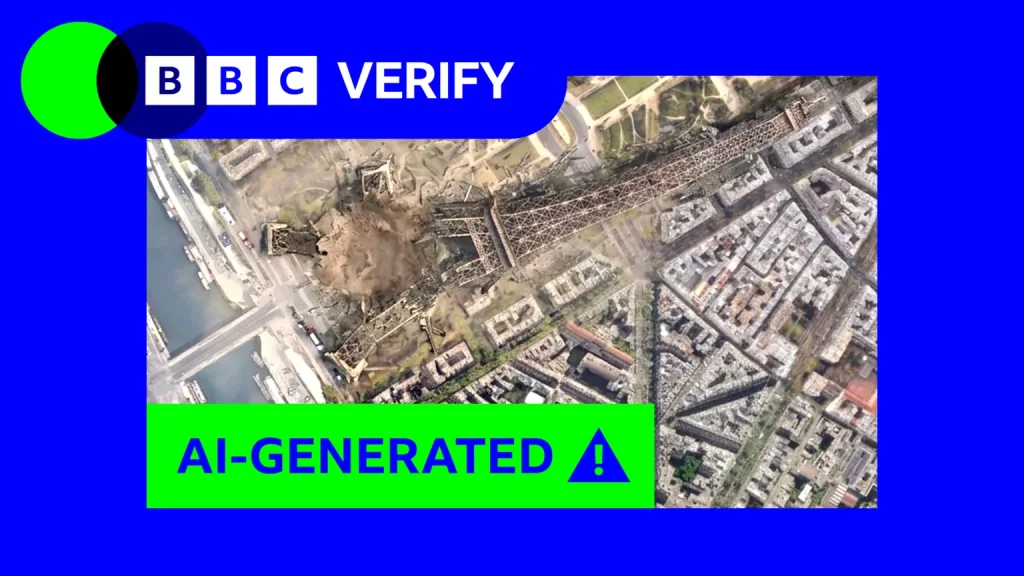
What Was Google’s New AI Tool?
Google’s latest Google Earth update introduced a feature powered by its Nano Banana 2 artificial intelligence model.
Unlike traditional AI image generators that create entirely fictional pictures, this technology allowed users to overlay AI-generated content onto authentic Google Earth imagery.
Using simple text prompts, users could instruct the system to insert almost anything into real-world locations.
Examples included:
- Buildings that do not exist
- Military equipment
- Natural disasters
- Infrastructure projects
- Environmental damage
- Vehicles and crowds
- Landscapes altered by AI
Because the AI creations appeared on top of genuine satellite images and real geographical coordinates, the resulting pictures looked highly authentic.
Users could then download and share these images on social media, messaging platforms, or websites.
BBC Verify Demonstrates the Risks
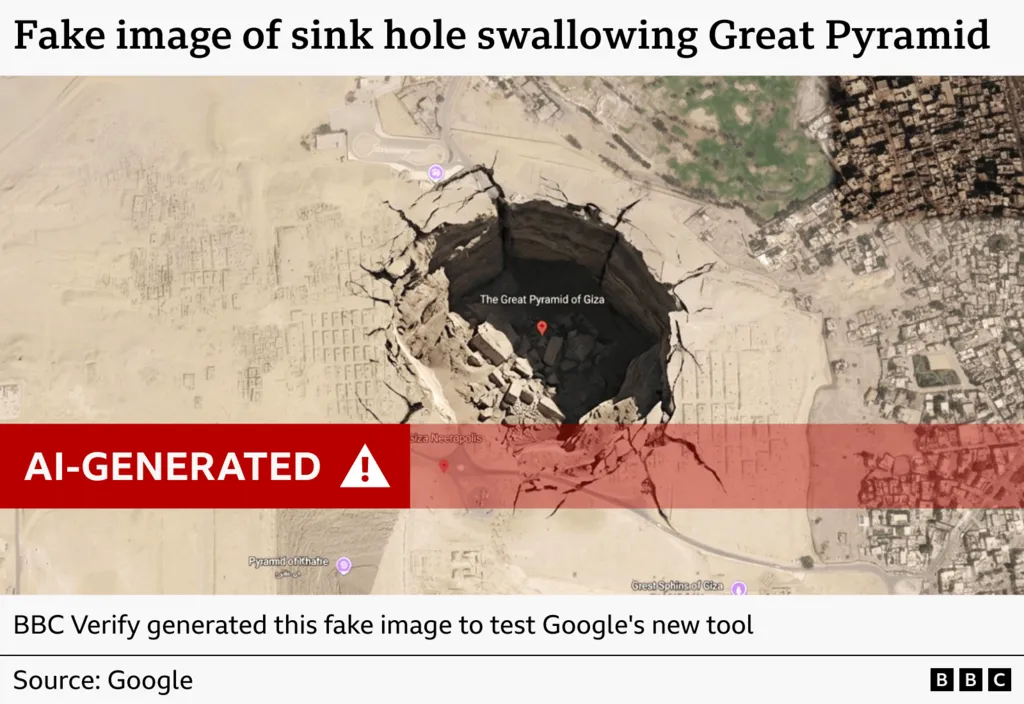
During testing, BBC Verify successfully created several fabricated satellite images using Google’s tool.
Among them were:
- A fake image showing the Eiffel Tower collapsed in Paris.
- A massive sinkhole swallowing the Great Pyramid of Giza.
- Russian military tanks positioned in central Kyiv.
- Other fictional disaster scenarios that appeared remarkably realistic.
Although none of these events had actually occurred, the images looked convincing enough to deceive viewers unfamiliar with the technology.
The experiment demonstrated how AI-generated satellite imagery could quickly become a powerful source of misinformation if shared without context.
Experts Warn of Serious Consequences
Digital misinformation specialists immediately expressed concern over the feature’s potential misuse.
Artificial intelligence researcher Henk van Ess warned that the technology blurred the line between reality and fiction.
During his own tests, he generated fake images depicting:
- A non-existent nuclear facility in Iran.
- A refugee camp along the United States-Mexico border.
- A hospital in Gaza with an AI-generated bomb crater nearby.
According to van Ess, the danger lies not simply in the images themselves but in their association with Google’s trusted mapping platform.
He argued that fabricated images inherit credibility because they appear within a service that billions of people already trust.
In other words, the map itself lends authenticity to false information.
Why Fake Satellite Images Are Especially Dangerous
Satellite imagery has traditionally been regarded as one of the world’s most reliable forms of visual evidence.
Governments, humanitarian organisations, journalists, military analysts, researchers, and emergency responders routinely depend on satellite images to verify events occurring in remote or inaccessible areas.
Because of this long-established trust, experts fear manipulated satellite images could have particularly serious consequences.
Fake images could potentially:
- Spread false reports during armed conflicts.
- Mislead emergency responders during disasters.
- Influence political debates.
- Damage public confidence in genuine satellite imagery.
- Fuel conspiracy theories.
- Manipulate financial or investment markets.
Unlike conventional AI-generated artwork, false satellite imagery may appear to come from an objective scientific source.
That makes it significantly more persuasive.
Google Responds by Suspending the Feature
Facing mounting criticism, Google acted quickly.
In a statement, the company confirmed that it was pausing the rollout of the AI feature.
Google explained:
“We have seen people sharing screenshots of generated imagery that appear to violate our policies.”
The company added that the suspension would remain in place while engineers implement stronger guardrails to prevent misuse.
Google also acknowledged the unique level of trust users place in Google Earth.
“We know that people uniquely trust Google Earth for a reliable view of the world.”
That recognition appears to have played a key role in the decision to withdraw the feature so soon after launch.
Existing Safety Measures Were Not Enough
Google said the tool already included several safeguards.
These included invisible digital watermarks designed to identify AI-generated content.
Users could also verify suspicious images using:
- Google Gemini
- Google Lens
However, BBC Verify found that these protections were not always reliable.
In some cases, researchers successfully persuaded Gemini to incorrectly identify fake Google Earth images as genuine.
Independent AI detection software also struggled to identify certain manipulated images.
Those findings suggested that current AI detection technology remains imperfect.
Researchers Found Ways Around Google’s Restrictions
Google initially stated that the AI system would refuse to generate harmful or dangerous content.
Yet BBC Verify demonstrated that simple changes to prompts could bypass many of these restrictions.
For example:
A request to generate a platform for executing traitors beside the UK Parliament was rejected.
However, using less direct wording allowed the AI to create a similar structure.
Likewise, the system refused a request to write the word “Trump” on the White House lawn but accepted other unrelated modifications in exactly the same location.
These examples raised questions about whether existing safeguards were sufficiently robust.
Threats During Global Crises
AI detection specialist Henry Ajder warned that fake satellite images could prove especially dangerous during rapidly evolving international crises.
In conflict zones or natural disasters, verified information is often limited.
False satellite images could therefore spread rapidly before journalists or authorities have an opportunity to confirm their authenticity.
Ajder noted that professional journalists typically verify imagery before publication.
However, ordinary social media users may unknowingly share fabricated content, allowing misinformation to spread widely within minutes.
That concern is particularly significant during wars, elections, humanitarian emergencies, and major natural disasters.
Trust in Satellite Imagery at Risk
Geospatial analyst Bill Greer, co-founder of the non-profit satellite organisation Common Space, also expressed concern.
He warned that public confidence in satellite imagery could gradually erode if convincing AI-generated images become commonplace.
According to Greer, governments around the world are already limiting access to certain satellite data.
If genuine imagery becomes less available while fake images become easier to produce, distinguishing truth from fiction could become increasingly difficult.
That loss of trust would have significant implications for journalism, humanitarian work, scientific research, and international security.
Growing Challenges of Generative AI
Google’s decision highlights one of the biggest challenges facing artificial intelligence companies.
Generative AI has become increasingly capable of producing highly realistic images, videos, audio recordings, and documents.
While these technologies offer enormous benefits for creativity, education, entertainment, and business, they also create new opportunities for deception.
Technology companies are therefore under increasing pressure to develop stronger safeguards before releasing powerful AI tools to the public.
The Google Earth incident demonstrates how quickly innovative technology can become controversial when adequate protections are not yet in place.
What Happens Next?
Google has not announced when—or if—the AI feature will return.
The company says engineers are working to strengthen its safety systems before considering another rollout.
Future versions of the tool are expected to include more effective content restrictions, improved AI detection capabilities, and stronger protections against misinformation.
Whether those measures will satisfy researchers remains to be seen.
Google’s decision to suspend its new AI-powered Google Earth feature just two days after launch reflects the growing tension between technological innovation and public trust.
Although the feature showcased the remarkable capabilities of modern artificial intelligence, it also demonstrated how easily realistic fake satellite images could be used to spread misinformation.
As AI continues to evolve, companies will face increasing pressure to balance innovation with responsibility.
For now, Google’s rapid withdrawal serves as a reminder that in the age of generative AI, protecting the credibility of trusted information sources has become more important than ever.
Google Earth
Google Earth imagery
Source: BBC
Also read: AI in healthcare: AI Could Transform Healthcare Faster Than Expected in 2026
Continue Reading
Data Centre Backlash: Why AI’s Rapid Expansion Is Facing Local Opposition
Artificial intelligence is developing at extraordinary speed, but the infrastructure powering that revolution is creating a problem that is much more local and increasingly political. Behind every artificial intelligence-generated image, video or answer are enormous data centres filled with powerful computer chips. These facilities require vast amounts of electricity, generate substantial heat and, depending on […]
Frank Ocansey

AI-Generated Complaints Are Overwhelming Councils and Schools: Here’s Why
AI-Generated Complaints Are Overwhelming Councils and Schools, But They Are Also Giving More People a Voice Artificial intelligence is making it easier than ever for people to challenge decisions, write formal complaints and quote regulations. But councils, schools and other public bodies are warning that the same technology is creating a huge new administrative burden. […]
Frank Ocansey

Japan AI adoption: Why Japanese Companies Are Slow to Adopt AI Despite Labour Shortages
Japan AI adoption: Japan is facing labour shortages, an ageing population and weak productivity growth, yet businesses across the country remain cautious about adopting artificial intelligence. What is holding Japan back from the Artificial intelligence revolution? Artificial intelligence is transforming workplaces around the world, but Japan appears to be moving at a much slower pace. […]
Frank Ocansey