
Why India Stock Market Is Falling Despite 7% Economic Growth

Frank Ocansey
Editor, PulseView
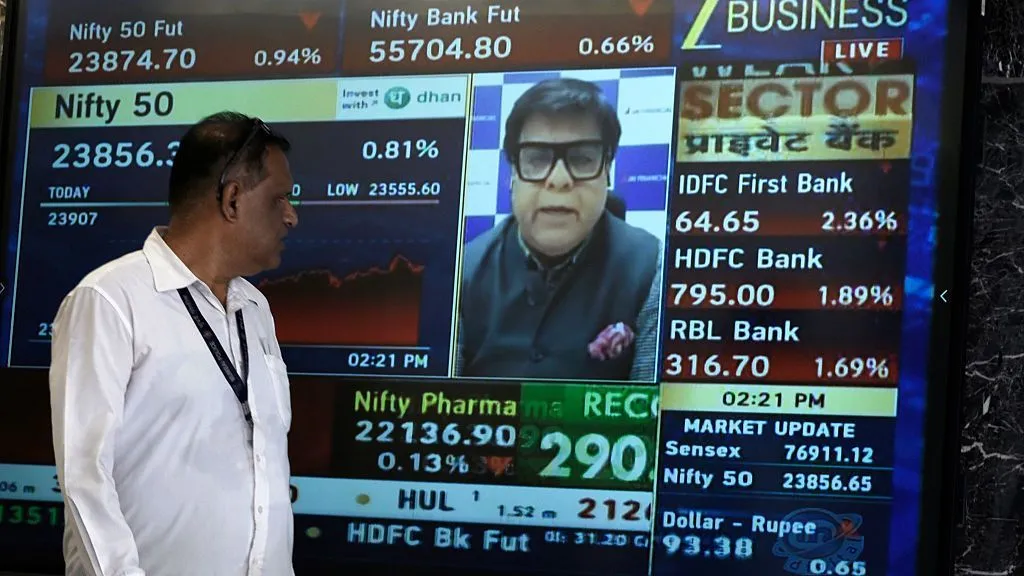
India Stock: India’s economy continues to expand at a pace that many countries would envy, yet its stock market is telling a very different story.
The world’s fastest-growing major economy is expanding at more than 7%, despite energy shocks, higher global interest rates, trade uncertainty and weather-related disruptions. But Indian equities have become one of the weakest-performing major markets in 2026.
The country’s benchmark Sensex and Nifty recently endured eight consecutive weeks of losses; the longest such losing streak in 25 years; before making a modest recovery.
For millions of Indian households investing directly or through mutual funds, the downturn is becoming increasingly significant.
The Nifty has fallen by around 15% this year, while investors in markets such as South Korea have enjoyed dramatically stronger returns. At the same time, foreign investors have withdrawn enormous amounts of capital from Indian equities.
So why is India’s booming economy failing to translate into stronger stock-market performance?
Here are five major reasons.
1. Middle East Conflict Is Keeping Energy Prices High
The biggest immediate problem for India is the cost of energy.
Crude oil prices have remained around $90 to $100 a barrel as disruption to shipping through the Strait of Hormuz continues.
For India, that is particularly damaging because the country imports more than 90% of its crude oil requirements.
A significant share of India’s crude oil, LPG and LNG supplies also passes through the Strait of Hormuz, making prolonged disruption particularly uncomfortable for the world’s third-largest oil-consuming economy.
When oil prices rise sharply, the effects spread throughout the economy.
Higher fuel costs can increase transportation expenses, raise production costs and put upward pressure on inflation. Companies may also see their profit margins squeezed if they cannot pass higher input costs on to consumers.
Hari Shyamsunder of Franklin Templeton Asset Management India told the BBC that markets can generally absorb crude prices in the $70-$90 range, but prices above $100 begin putting pressure on inflation, corporate earnings and margins.
That creates a difficult environment for Indian equities.

Russia Adds Another Layer of Uncertainty
India has attempted to diversify its energy supplies, including increasing its use of Russian oil.
But geopolitical tensions surrounding Russia have created another source of uncertainty.
The source notes that US President Donald Trump has threatened tariffs of up to 100% on countries conducting trade with Moscow, potentially complicating India’s energy and trade calculations.
For investors, uncertainty over India’s future energy costs makes it harder to estimate corporate earnings.
2. Higher Global Interest Rates Are Pulling Money Away From India
The second problem is the global interest-rate environment.
When inflation rises, central banks can come under pressure to maintain or increase interest rates.
The source notes that yields on US government bonds have risen above 5%, reaching levels close to 25-year highs.
For international investors, US government bonds are generally regarded as relatively low-risk assets.
That creates a powerful incentive for investors to move money away from emerging markets when US yields become sufficiently attractive.
Why take currency and political risks in an emerging market such as India when investors can potentially earn attractive returns from US government securities?
This dynamic can lead to foreign capital leaving Indian equities.
And when large international funds sell Indian shares, downward pressure can spread across the market.
3. The Weak Rupee Is Making Indian Stocks Less Attractive to Foreign Investors
Even when an international investor makes a return on Indian shares, currency movements can reduce the value of that return when converted back into dollars.
The Indian rupee’s weakness has therefore compounded the problems facing foreign investors.
The source notes that the Nifty has generated only around 6% annualised returns in US-dollar terms over the past decade.
That matters because global investors compare markets on a currency-adjusted basis.
A market can perform reasonably well in local currency but still appear less attractive to an international investor if the local currency is losing value.
The combination of weaker stock returns and a weaker rupee therefore makes India’s equity market less compelling compared with alternative destinations.
4. Indian Stocks Have Fallen—but They Are Still Expensive Compared With Some Rivals
Another important issue is valuation.
Indian stocks have become cheaper following the market correction of the past two years.
But cheaper does not necessarily mean cheap.
Indian equities have historically traded at a premium compared with many other emerging markets. That premium has narrowed, but valuations remain relatively high compared with some competing markets.
This creates a problem for investors.
If Indian companies are trading at relatively expensive valuations while companies elsewhere are delivering stronger earnings growth, international investors may decide that their money can generate better risk-adjusted returns elsewhere.
The comparison with Asian markets is particularly important.
Companies in countries such as South Korea and Taiwan have benefited from the global artificial-intelligence boom, which has significantly increased profits in parts of their corporate sectors.
India has not yet enjoyed a comparable AI-driven earnings surge.
5. India Does Not Yet Have a Global AI Giant
Perhaps the most structural issue is India’s position in the new technology economy.
India has become one of the world’s major technology and services centres, but it has not yet produced a globally dominant AI company comparable to OpenAI, Anthropic or China’s DeepSeek.
That matters because some of the biggest profits from the AI revolution are being captured by companies developing the underlying technologies rather than simply using them.
India is investing in areas such as data centres, semiconductor manufacturing and advanced technology.
But many of its emerging technology companies remain too small to materially change the country’s overall stock-market earnings picture.
Bernstein Research has argued that many of India’s large companies represent an older phase of economic development and are not investing aggressively enough in future industries.
The research house also points to emerging opportunities in space, defence, semiconductors and deep technology, but says many of these industries remain too small to significantly influence capital allocation decisions for much of the decade.
Foreign Investors Have Been Pulling Billions Out
The combination of these pressures has produced a dramatic change in foreign investor behaviour.
Over the past decade, the net amount of foreign money invested in Indian markets after accounting for withdrawals and sales has been approaching zero.
Over just the past two years, foreign institutional investors have reportedly withdrawn around $40 billion, according to Bernstein Research.
That is a major reversal for a country that has long been one of the world’s most attractive emerging-market investment destinations.
But the market has not collapsed entirely because Indian households and domestic institutions have stepped in.
Indian Households Are Providing a Safety Net
Domestic investment has become an increasingly important force in India’s financial markets.
Assets under management in Indian mutual funds have expanded from approximately $125 billion in 2016 to around $900 billion this year.
The number of Indians investing in stocks and mutual funds has also more than tripled to approximately 150 million people.
This huge domestic investor base has helped cushion the impact of foreign capital leaving the market.
Monthly contributions to mutual funds have continued even during the downturn, demonstrating how deeply equity investing has become embedded in household savings.
But this resilience comes with a potential downside.
If the correction becomes substantially deeper, millions of ordinary Indian savers could feel the impact directly.

India has one of the world’s worst performing major equity markets in 2026
The Market’s Weakness Is Arriving at a Difficult Time for Households
The stock-market correction is not happening in isolation.
Indian households are already dealing with concerns around employment, inflation and weaker consumption.
For families that have increasingly moved their savings into stocks and mutual funds, falling equity prices can therefore affect household wealth and confidence.
This creates a potential feedback loop.
If households become more cautious because their investments are falling, they may reduce discretionary spending. Weaker consumption could then put additional pressure on corporate earnings.
The full effect will depend on how long the market correction lasts and how severely corporate profitability is affected.
What Could Turn India’s Stock Market Around?
The outlook is not necessarily permanently negative.
Several factors could help reverse the decline.
A reduction in geopolitical tensions could ease pressure on energy prices and improve investor confidence. More attractive valuations could also encourage foreign investors to return.
CareEdge, the brokerage cited in the source, expects easing geopolitical tensions and relatively attractive valuations could support a recovery in foreign portfolio investment.
However, it also warns that trade tensions and elevated energy prices remain challenges for corporate performance.
Corporate Earnings Will Be the Next Big Test
One of the most important developments for investors will be corporate earnings.
As Indian companies begin reporting quarterly results, investors will gain a clearer picture of how higher energy costs, weaker consumption and other pressures have affected profit margins.
Strong earnings could provide a reason for investors to reconsider Indian equities.
Weak earnings, on the other hand, could reinforce the argument that Indian stocks remain too expensive relative to their growth prospects.
The market’s future direction may therefore depend less on India’s headline GDP growth and more on whether that growth translates into stronger corporate profits.
A Fast-Growing Economy Does Not Automatically Mean a Rising Stock Market
The apparent contradiction between India’s economic growth and stock-market weakness is important.
A country’s GDP can grow rapidly while its stock market falls.
Stock prices reflect expectations about future corporate earnings, valuations, interest rates, currency movements, capital flows and investor sentiment—not simply current economic growth.
India may therefore continue expanding at more than 7% while investors remain cautious about the prices they are willing to pay for Indian companies.
That is the central issue facing the market.
What Happens Next?
For now, domestic investors continue to support Indian equities even as foreign investors pull money out.
That has prevented a potentially sharper decline, but it cannot guarantee that the market will remain resilient indefinitely.
The crucial questions are whether energy prices fall, whether the rupee stabilises, whether global interest rates become more favourable, whether corporate earnings recover and whether India can produce globally competitive businesses in industries such as AI, semiconductors and deep technology.
If those conditions improve, foreign capital could eventually return.
If they deteriorate further, India’s stock-market correction could have much further to run.
The Bottom Line
India’s economy may still be one of the world’s fastest-growing, but investors are looking beyond GDP growth.
High oil prices, elevated global interest rates, a weaker rupee, relatively expensive valuations and the absence of a major AI-driven corporate boom are weighing heavily on Indian equities.
The market has already become cheaper, but investors want evidence that India’s companies can deliver the earnings growth needed to justify their valuations.
For now, India’s 150 million retail and mutual-fund investors are helping keep the market afloat.
The bigger question is whether that domestic resilience will survive if the correction becomes significantly deeper.
India’s economy is growing above 7%, but its stock market is struggling. Here are five reasons Indian stocks are falling, from oil prices and interest rates to the weak rupee and AI.
Source: BBC
Also read: Dangote Backs $660m Ethiopia-Djibouti Fuel Pipeline to Boost Energy Security
Continue Reading

Ato Forson Says Five Statutory Funds Receive Full Q3 2026 Payments
Finance Minister Dr Cassiel Ato Forson has announced that five major statutory funds in Ghana have received their third-quarter allocations for 2026 in full and on time. The funds support key sectors, including education, healthcare, road maintenance and local development. Finance Minister Dr Cassiel Ato Forson says the government has fulfilled its third-quarter 2026 payment […]
 Junior Kojo

Ghana Government Pays GH¢24.8 Billion to Statutory Funds in 2026, Ato Forson Announces
Finance Minister Dr Cassiel Ato Forson has announced that the government has paid GH¢24.8 billion into various statutory funds since January 2026, insisting that the releases have been made on time and in full. The payments are intended to support education, healthcare, road maintenance, local government administration and other essential public services across Ghana. The […]
Junior Kojo

Dangote Backs $660m Ethiopia-Djibouti Fuel Pipeline to Boost Energy Security
Africa’s industrial expansion is gaining another major infrastructure boost after Nigerian billionaire Aliko Dangote announced plans to help finance a $660 million fuel pipeline linking Ethiopia and Djibouti. The major energy project is expected to improve the movement of petroleum products into landlocked Ethiopia, reduce transportation times and strengthen the country’s fuel supply chain. The […]
Frank Ocansey